
Distributed AI in Industry-4.0 Production Systems
Four miniature factories, each run by a neural network, each learning at its own pace – and able, when it matters, to forget. This DFG-funded study examined what happens when neuronally instructed production sites are connected into a chain, and delivered the demonstrator to find out.
DFG – Priority Programme 1921 (start-up funding)
2023 – 2024
Applicant and principal investigator
Open demonstrator on GitHub
Behind this project stands an idea developed in the doctoral thesis of this chair: the Concept of Neuronal Modeling, CoNM. It allows bounded systems – machines, business processes – to be modelled with artificial neural networks, and machines to be instructed through them: what a machine perceives of its environment is injected into the network as activation, and what the network computes becomes the machine’s next step. Because the behaviour of the network is visible during training and operation, something unusual becomes observable: one can watch such a system learn – and watch it unlearn. Intentional forgetting, usually a metaphor, becomes a process one can point at.
The thesis demonstrated all this on a single model production plant. The obvious next question was also the hard one: what happens when there are several? Real production chains span sites run by different operators, and neuronally instructed sites follow their own activation cycles and activation rates – their own pulse. Whether a chain built from such sites still delivers reliable quality, and how those pulses must be tuned so that it does, nobody had examined.
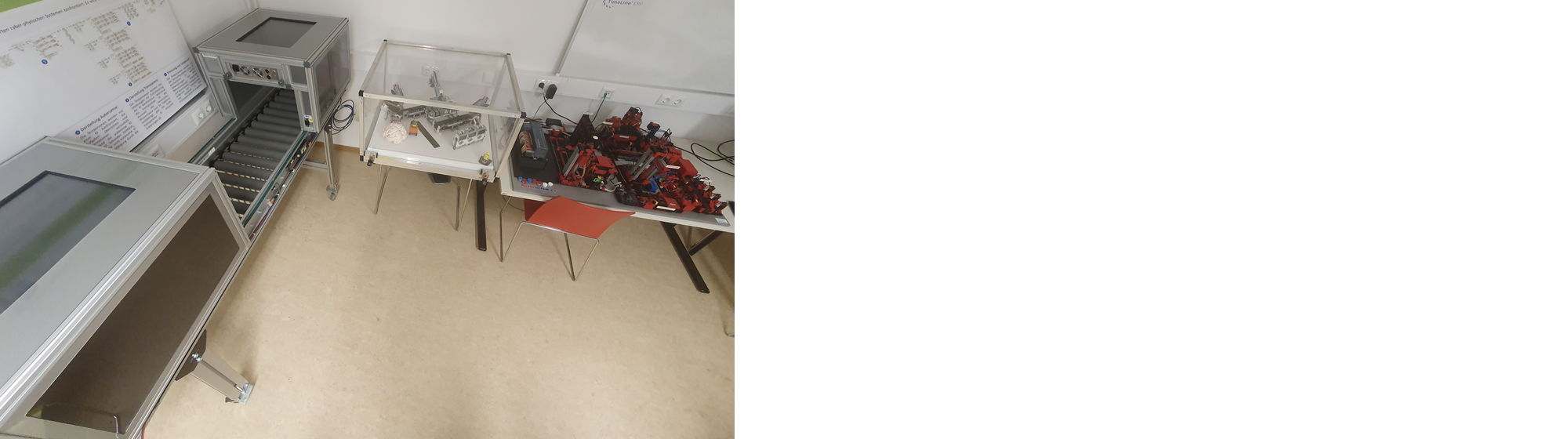
Four Factories on One Table
With start-up funding from the DFG Priority Programme 1921, the single-site model plant was extended into four distributed production sites, each modelled neuronally with CoNM. Activation rates and cycles were varied systematically, and their effect on the quality and speed of the production chain was measured. The study delivered what start-up funding is meant to deliver: evidence that the larger question deserves a full research project, systematic findings on how the timing parameters of distributed neural production affect what comes off the line, and a working demonstrator of intentionally learning – and forgetting – cyber-physical systems.
The demonstrator and its documentation are openly available on GitHub, so the experiments can be reproduced and extended. The line of work has continued since: the self-learning factory built on these foundations won silver at the Factory Innovation Award 2026, with the jury explicitly praising the explainable decisions of its neural twins. What began as four small factories on a table has become the backbone of a research programme on production systems whose intelligence can be inspected – not merely trusted.