
GreenAI – Energy-Aware AI in Heterogeneous, Federated Infrastructures
Every answer an AI gives has a price in electricity – it just never appears on a bill. This project builds the instruments that make the energy consumption of AI systems measurable across their whole lifecycle, and shows how much of it can be saved without anyone noticing a difference in the result.
AiF / Central Innovation Programme for SMEs (ZIM)
01 Aug 2024 – 31 Dec 2026
Applicant, principal investigator, consortium coordination
220,000 EUR
Artificial intelligence has an energy problem, and it is growing faster than the awareness of it. Training a model consumes electricity; so does every single query afterwards. Current development practice barely accounts for this: what counts is accuracy, speed and time to market, because that is what customers pay for. As AI spreads through companies, administrations and homes while energy stays scarce, this way of building AI systems reaches its limit.
The obvious answer – just measure the consumption – turns out to be the hard part. AI computation is distributed across heterogeneous infrastructures: a laptop here, a GPU server there, a cloud region somewhere else, each with its own hardware, utilisation and energy mix. Existing approaches to sustainable AI can barely measure, let alone steer, what a given AI task consumes across such a landscape. Whoever wants to call an AI application green first has to answer a simple question nobody could answer so far: green compared to what, measured how?
Measuring the Invisible
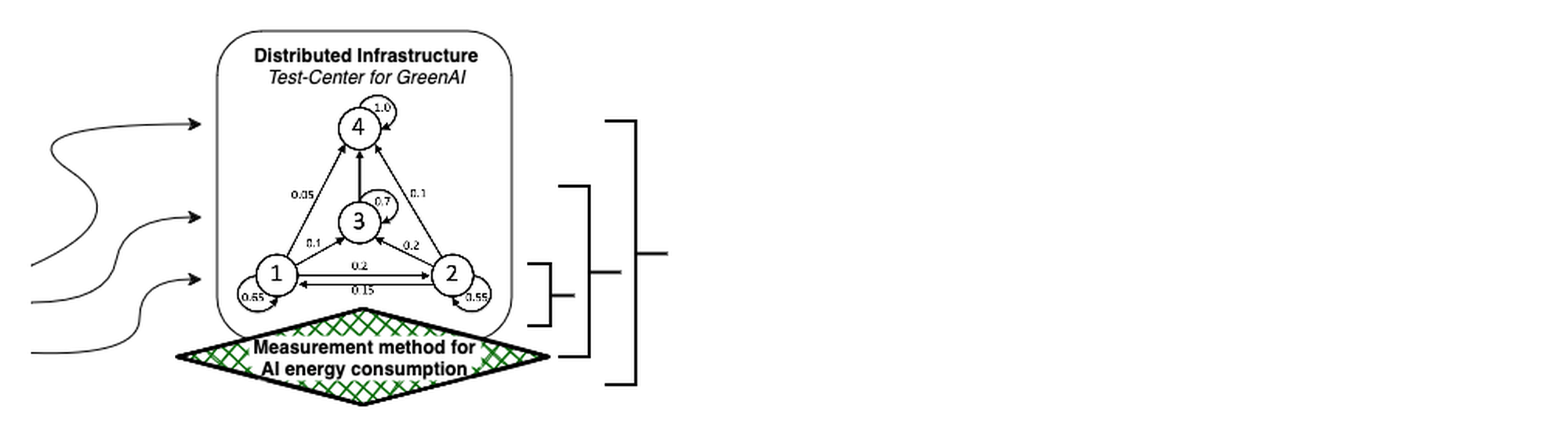
GreenAI answers it by overlaying two measurement worlds. Physical meters record what the hardware actually draws from the socket; software-side telemetry records what the systems report about themselves. Both are sampled at high frequency and aligned, so that consumption can be attributed to an individual AI task – this training run, this query, this model – rather than to a server that also did other things that day. On top of this measurement layer, the project develops distribution strategies: AI tasks are routed dynamically across the available infrastructure and evaluated against energy, CO₂ emissions, runtime and result quality at the same time.
The numbers make the point better than any manifesto. In the chair’s Test-Center for GreenAI – 48 AI computers with heterogeneous architectures, SME-typical systems and four independent, simultaneously operating electricity and CO₂ measurement systems – energy-aware task distribution reduced consumption by up to 46 percent, at the cost of roughly one additional second of runtime. That is the kind of trade-off most users would accept without noticing, and most operators would sign immediately.
From Measurement to a Label That Means Something
The project, funded through the Central Innovation Programme for SMEs and carried out with Krallmann AG as industry partner, condenses its findings into recommendations for organisations – which hardware for which task, when the cloud beats the basement and when it does not – and into a certification logic that makes the label GreenAI verifiable rather than decorative. The measurement approach has been shown publicly at Hannover Messe 2026 and GITEX AI Europe 2026. For research, the contribution is a measurement method where there was estimation; for everyone who operates AI, it is an answer their next sustainability report will ask for.