
WiTrAI – AI Interventions in Recurring Knowledge Transfer Situations
Every working day, development teams around the world stand together for fifteen minutes and talk. Those minutes decide whether knowledge reaches the person who needs it – and this project builds an AI system that can watch that transfer happen in real engineering teams, recognise its patterns, and step in where it stalls.
German Research Foundation (DFG)
2026–2029
Applicant and principal investigator
299,001 EUR (share M. Grum)
The daily stand-up is one of the most successful rituals modern engineering has produced. Agile teams in software and mechatronics use it to cope with uncertainty: every morning, everyone says what they did, what they will do, and what is blocking them. The ritual – Scrum calls it the Daily Scrum – is short, cheap and universal, and it is where a project’s most valuable resource changes hands. Not code, not budget: knowledge.
Whether that hand-over works is largely a matter of luck. One team member explains a problem in terms nobody else uses; another mentions, in passing, the one detail a colleague will need three days later; a third says nothing at all. Research has shown in laboratory experiments that knowledge transfer can be measured and improved – earlier DFG projects in the research line behind this chair measured how fast and how well knowledge travels in product development, and what influences both. But laboratories are patient, and stand-ups are not. Until now there has been no way to recognise transfer patterns automatically in a real, running development team, and no way to decide which intervention would actually help in a given situation.
An AI That Listens to the Stand-up
This is the gap WiTrAI closes. The project treats the daily stand-up of agile mechatronic engineering as a research case and builds an AI system around it. Data from the meetings is collected and prepared so that the system can learn what a productive transfer looks like – and what a stalled one looks like. Because feedback that arrives a day later changes nothing, the system is designed for real-time infrastructures: it recognises a pattern while the meeting is still running.
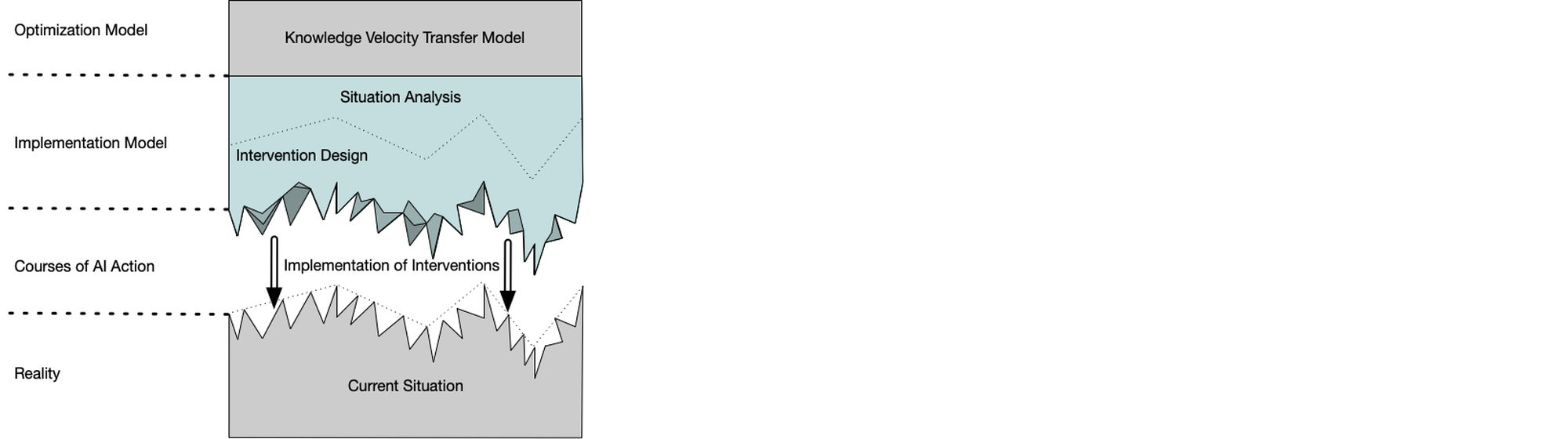
Recognising is only half the task. The scientific core of the project is the step from pattern to intervention: which methodical change – a different question, a different order, a different medium – improves the transfer that just failed? Each candidate intervention is evaluated experimentally rather than assumed to work. The approach is design-oriented and experiment-driven throughout: the AI system is built as an inspectable research artefact, its recommendations are tested against measured outcomes, and the findings are condensed into recommendations that teams outside the study can apply.
Three Institutions, One Question
The project brings together three perspectives that rarely share a room: this chair contributes the AI-based application systems and the experimental method, the chair of Business Information Systems, esp. Processes and Systems at the University of Potsdam (Prof. Dr.-Ing. habil. Norbert Gronau) the knowledge transfer research line, and the IPEK Institute of Product Engineering at the Karlsruhe Institute of Technology (Prof. Dr.-Ing. Dr. h.c. Albert Albers and Univ.-Prof. Dr.-Ing. Tobias Düser) the reality of agile mechatronic development. For practice, the promise is concrete: an account of a team’s knowledge flows that does not rely on self-assessment, and interventions that have been tested rather than recommended. For research, the project moves an entire experimental tradition out of the laboratory and into the place where knowledge transfer actually earns its keep – fifteen minutes at a time.